
Introduction
After completing the modules on Takiwātanga for my specialist teaching course, a type of strategy that stood out to me was the use of visual supports. I adapted these suggestions from Jennifer Ganz’s Classroom Structuring methods and strategies for children and youth with Autism (2007).
Children with dyslexia, ADHD, autism and/or auditory processing disorder tend to have stronger visual processing skills than language processing (Ganz, 2007). To ease the challenge of verbal processing we can increase visual information within our classroom environments.
Below I am going to summarise some visual tools you can implement simply and quickly both at home and at school to ease transitions, help students stay on track with their learning and to support them when things get too much (Ganz, 2007).
Visual schedules:
You may have already come across a visual schedule in your own life.
They are as the name suggests a schedule that is visual.
For young learners, this can look like a series of pictures showing them what to do when they come into the classroom at the start of the day.
For older students, it may be a checklist of step-by-step instructions that they can work through independently. When visual schedules are used effectively they allow activities to be anticipated, and learners to know exactly what to expect. They allow students to feel autonomy and control over their learning (Ganz, 2007).
Takiwātanga students involved in making their schedule will also feel more relaxed and more ownership over their learning time.
Schedules support the development of executive functioning like organising and prioritising tasks, managing time, and keeping track of where they are in their learning.
Types of visual schedules you can try:
Young learners:
Create pictures of daily routine tasks, laminate these and attach them with velcro to a laminated card. Learners can stick the tasks in order and remove them as they are complete.
Alternatively, they can start with the tasks and add them as they are completed.
Create a visual schedule of a task e.g. maths tasks or handwriting time. Break down the steps into picture cues. Use a pointer with velcro to move along as students get through the steps in the task.
You can see some fantastic examples at this website.
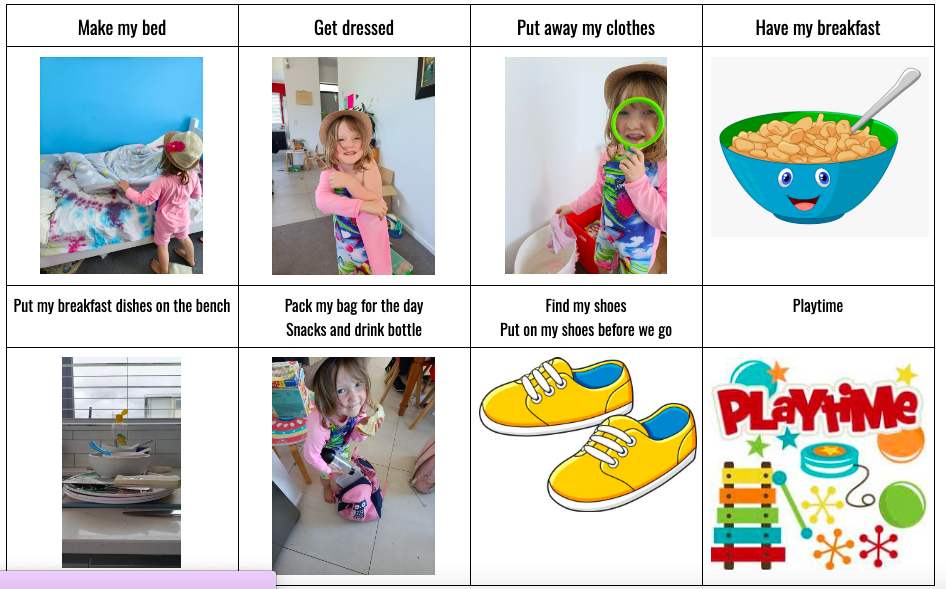
Here is one I designed for my daughter:
I cut out the pictures and had it on a big piece of A1 cardboard and we could velcro on and off the cards as needed.
Older learners:
– provide a laminated checklist that has been co-constructed for an activity that is challenging e.g. getting ready for school in the morning.
- Use the checklist with a whiteboard marker to cross off tasks or tick them off as they are completed

Now, Next, Then charts
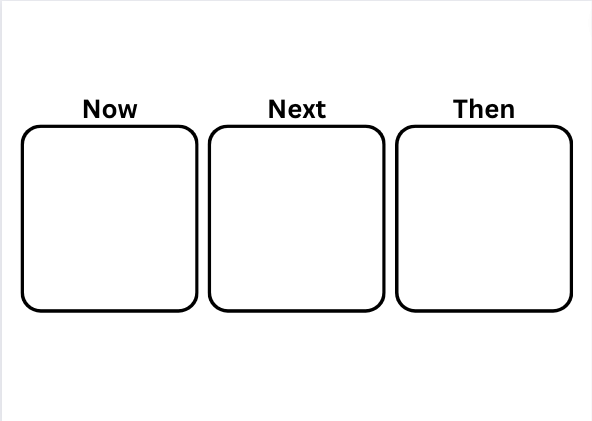
This very simple visual schedule has three boxes with the headings “Now, Next, Then”. The theory of this schedule is that students will work through two tasks that are less desirable or interesting to them and then move on to the “Then” activity which would be something they are looking forward to.
The reason this type of schedule works for learners is that it breaks down the work into very discreet chunks and clearly outlines when the learner will next receive a break.
I have used this successfully with students to enable them to focus for a set period of time. Two activities or steps are much easier to handle than a whole list of instructions. They can also help the learner re-focus if they have become distracted.
To set up this visual schedule, you can use this template
This is also an excellent article about the rationale behind this type of visual schedule.
Then either draw in collaboration with the student what is going to happen or design and pre-print regularly occurring activities to velcro on and off as they occur.
Visual break cards
Sometimes our tāmariki can become overstimulated or emotionally dysregulated in our classroom environments and can find it difficult to communicate this with the adults around. Autistic students especially can struggle to express their emotions and will often mask difficulties in large environments like schools.
Kaiako and whānau can make it easier for their tamariki to ask for help by creating a visual break card. This card is about the size of a bank or credit card. It is laminated and can be kept in the students’ pockets during the school day.
At a quiet time the student, the whānau and kaiako can work together to decide on three activities or safe spaces that a student can retreat to when things get too much.

In the example below I have added headphones (for music or meditation or an audiobook), a bean bag (somewhere quiet and soft to relax) and the outdoors (playground for sensory stimulation). You can access my template here.
When the student feels they are in need of a break for whatever reason, they can discreetly hand their card to their kaiako. This communicates that they are going to re-set and will come back within an agreed timeframe.
An agreed time frame should use a visual aid like a time timer or sand timer where it is obvious when time is running out. The student should return to the teacher for their card when it runs out and they are ready to work again. If possible it is good to take time to check in with the student once they have returned to make sure they are ok and to offer support.
Pointers for implementation:
- These visual schedules need direct and explicit teaching for students.
- You may spend up to 6 weeks implementing these strategies, before slowly removing your prompting and building students’ ability to use the strategy on their own.
- Once the student has got mastered one subject/area of your class time, extend it into other parts to promote generalisation, as the generalisation of strategies like this may not come automatically.
- Make sure that the student has been involved in as much of the process as is developmentally appropriate.
- Store the visual schedules in a central place that is easy to reach and make it part of the daily routine to check them.
For more information about visual schedules try the following links:
Raising Children Australia: https://raisingchildren.net.au/autism/therapies-guide/visual-supports
Children’s Autism Services, Edmonton Fact sheet: https://childrensautism.ca/wp-content/uploads/2018/04/visual-schedule-tipsheet.pdf
Talklink Tip of the Month: Visual Schedules: https://talklink.org.nz/resources/tip-of-the-month-march-2019-visual-timetables
References:
Ganz, J. B. (2007). Classroom Structuring Methods and Strategies for Children and Youth with Autism Spectrum Disorders. Exceptionality, 15(4), 249–260. https://doi.org/10.1080/09362830701655816

 Georgi de Stigter